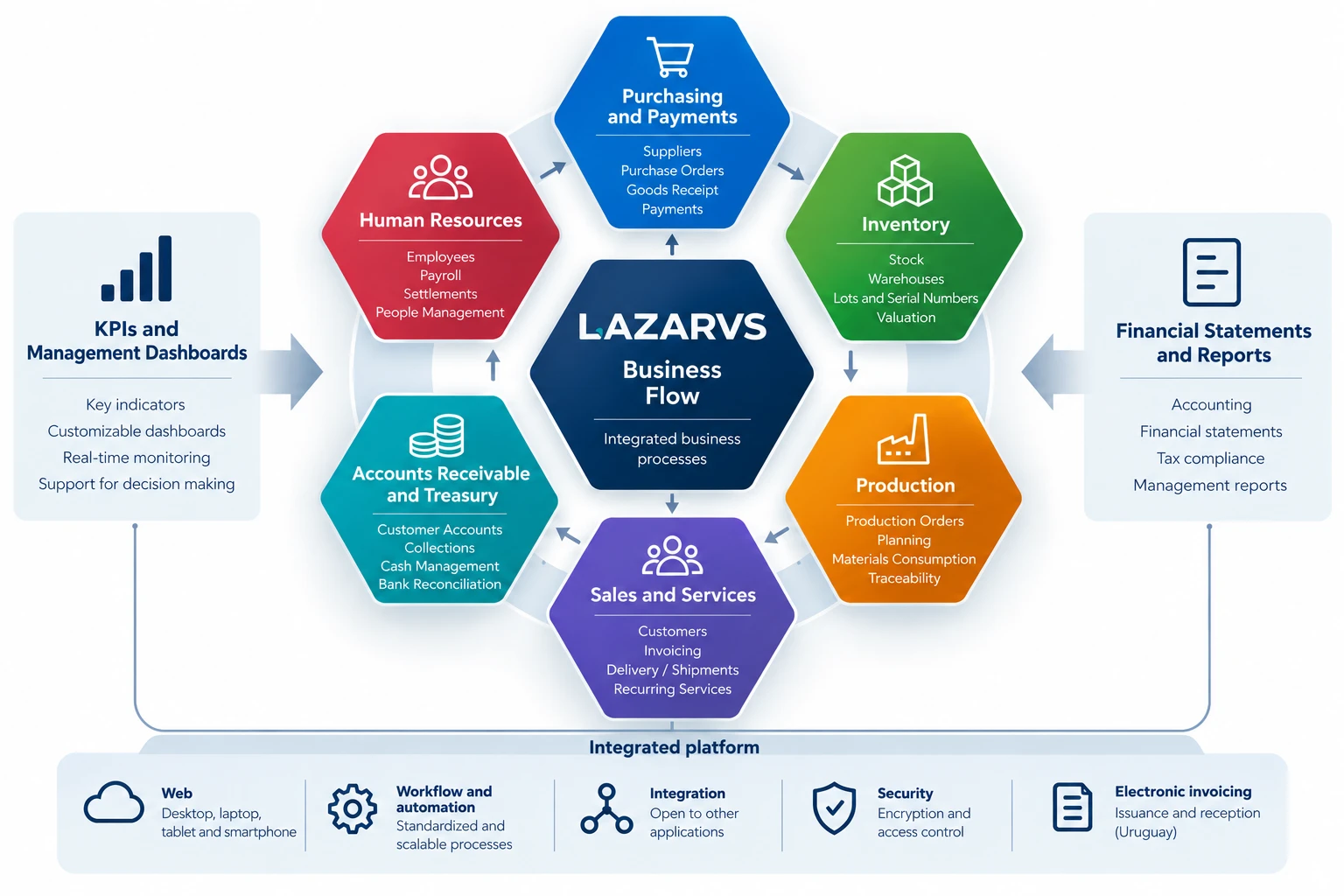
LAZARVS is a comprehensive enterprise management solution, accessible through a web browser on desktop computers, laptops, tablets, and smartphones.
It integrates administrative, financial, commercial, and operational processes into a single platform, enabling task automation, process standardization, and operational control.
Its integrated workflow functionality enables organizations to define review and approval processes, reducing manual tasks and the need for paper-based documentation.
Through its Key Performance Indicators (KPIs), financial statements, and forecasting capabilities, LAZARVS enables organizations to monitor performance, assess progress toward objectives, and anticipate business results to support informed decision-making.
It includes electronic invoicing for Uruguay, automating the issuance, receipt, and processing of electronic invoices.
LAZARVS uses security and encryption mechanisms to protect information and supports integration with other applications.
Business flow
Your whole company, in one system
LAZARVS modules share the same information: each piece of data is entered once and is available to every area.
During application implementation, all company business processes are modeled following BPM methodology, where we determine operations flows and business rules to accomplish. Those rules are defined in this module and allow a flexible definition based on the company possibilities. Among the module characteristics, we can find:
All business processes are associated to a workflow of revisions and approvals.
Different alternatives, approvers, reviewers and levels of approval can be defined.
It has approvals by
Department
Site
Warehouse
Plant
Project
Key Performance Indicators (KPIs)
LAZARVS enables organizations to measure and monitor business performance through Key Performance Indicators (KPIs) integrated into their business processes. It facilitates the tracking of financial, commercial, operational, and quality results, providing information to assess progress toward objectives, identify improvement opportunities, and anticipate future performance.
Its capabilities include:
Financial KPIsMonitoring historical, budgeted, and forecast results, enabling organizations to anticipate their financial position and performance at year-end.
General KPIsDefinition of indicators tailored to each organization's needs, including effectiveness, efficiency, quality, and achievement of objectives.
Quality ManagementMonitoring nonconformities and other indicators associated with continuous improvement processes.
SatisfactionMeasuring customer and employee satisfaction through surveys and specific indicators.
SalesAnalysis of sales trends and commercial performance.
ServicesMonitoring contracts, service delivery performance, milestones, and execution objectives.
PurchasingIndicators to assess purchasing activities and trends.
InventoryIndicators for inventory management and control.
ProductionMeasurement of manufacturing process performance.
Human ResourcesEmployee hiring and departure statistics, and workforce composition analysis by age group, gender, length of service, manager, and educational level.
CRM - Customer Relationship Management
Modern marketing and sales management requires structured tracking of relationships with existing and prospective customers. LAZARVS CRM supports the different stages of customer relationships and enables organizations to monitor associated commercial activities.
Lead management.
Sales opportunity management.
Sales pipeline and forecast reporting.
Contact management.
Meeting management.
Activity tracking.
Case management.
Sales performance indicators and opportunity tracking.
Accounting
Comprehensive accounting management, from fundamental accounting principles to advanced management accounting, financial analysis, and forecasting capabilities.
Multi-currency operations.
Automated bank reconciliations.
Account balance breakdowns.
Segment accounting.
Cost centers and hierarchical reporting.
Project accounting.
Revenue and cost matching.
Classification of transactions by nature.
Transaction traceability.
Flexible interfaces with other systems.
Automatic updates of official tax exchange rates.
Financial statements with automatic comparisons against budgets, prior-year results, and historical performance.
Year-end financial statement forecasts, enabling comparison of expected results against budgets and historical performance.
Financial KPIs to monitor the organization's financial position and performance.
Billing and Sales
This module supports customer deliveries and the invoicing of goods and services. Its capabilities include:
Invoicing of goods and services.
Recurring invoicing for periodic contracts.
Documentation and traceability of service contracts.
Multi-currency operations.
Invoicing of goods delivered through delivery notes.
Customer account management by transaction type (standard accounts, vouchers, checks, etc.).
Multiple configurable payment methods.
Revenue recognition on an accrual basis, regardless of billing frequency, including services recognized according to their progress when applicable.
Sales KPIs for analyzing sales trends and commercial performance.
Collections and Treasury
Funds are managed from a collections process point of view, but allowing flexibility to different approaches. The module includes:
Collection slips with multiple payment methods
Unassigned collections and application to invoices
Collection in any defined currency
Defined by Cash concept with cash report and funds availability
Limited minor expenses or petty cash
Group collections by disposition
Payment orders for miscellaneous items (Taxes, Advances, etc)
Services
For service-based organizations, LAZARVS provides comprehensive contract management, service delivery monitoring, profitability analysis, and proper revenue recognition.
The module supports both recurring services and those whose execution depends on milestones, hours worked, or percentage of completion.
Its capabilities include:
Management and monitoring of customer service contracts.
Definition of the different components and services covered by each contract.
Automated recurring service invoicing according to established billing schedules, preventing omissions.
Automated revenue accrual when billing frequency differs from the period in which services are delivered.
Monitoring of services based on milestones, hours worked, or percentage of completion.
Automated recognition and accounting of monthly service progress.
Allocation of resource hours and costs to individual projects.
Monitoring of contract, service, and project performance over time.
Performance indicators and milestone completion tracking.
Project-level cost, revenue, and margin reporting.
Purchasing
In an environment where purchasing requires increasing specialization, this module supports professional procurement management through structured processes and performance indicators.
Classification of purchases by specific categories.
Department-level purchase orders.
Supplier invoices, with or without associated purchase orders.
Digital storage of invoices, eliminating the need for paper documentation during review and approval processes.
Documentation of applicable tax withholdings.
Individual or bulk supplier payments through banking institutions.
Management of supplier advance payments.
Supplier account balances by currency.
Management of import and export shipments, including import costing.
Purchasing KPIs for monitoring and analyzing procurement activities.
Production
Production processes require planning, execution, and control. This module provides tools to manage every stage of production, control costs, and assess operational performance.
Variable costing, activity-based costing (ABC), and traditional costing methods.
Actual and standard cost calculations.
Single-product and joint production.
By-product management.
Definition of production processes and the relationships between their different stages.
Production planning and execution.
Traceability of production stages and related events.
Performance indicators to monitor the efficiency and evolution of production processes.
Inventory
Inventory management is based on structured product definitions, storage management, and inventory control using flexible, configurable criteria.
Physical inventory control by warehouse, location, lot (including expiration dates), and serial number.
Inventory costing based on accepted accounting methods.
Optional delivery notes.
Simultaneous invoicing and delivery.
Product receipt based on purchase orders, supplier invoices, or import shipments, enabling immediate costing.
Automated physical inventory counts, including recounts and discrepancy verification.
Separation of warehouse operations and inventory control responsibilities.
Inventory management indicators for stock analysis and control.
Fixed Assets
Manages and controls all Fixed Assets and their depreciation. It includes Property, Plant and Equipment as well as Investment Property and Intangible Assets. Its characteristics include:
Each asset held is clearly identified and associated
Uses cost centers for usage and depreciation charge
Defines responsibles to keep stock control
Allows all doctrinary depreciation methods
Allows revaluation based on fair value determined by appraisal or based on indexes
Flexible to operate monthly or anually
Tracks all activities by asset
Human Resources
Comprehensive human resources management, including employment history, payroll processing, compliance with labor regulations, and analysis of workforce trends and composition.
Employee employment history.
Payroll processing in accordance with applicable labor legislation.
Flexible configuration to accommodate legislative changes without requiring software modifications.
Calculation of periodically accrued employee benefits, including annual bonuses, vacation benefits, and other statutory entitlements.
Calculation of payroll-related accruals and provisions.
Automated accounting of payroll expenses and related provisions.
Employee hiring and departure indicators.
Workforce composition analysis by age group, gender, length of service, manager, and educational level.
Workforce statistics to monitor changes in staffing over time.
It is not about having an ERP.It is about your company working better.